The Tech Career Pivot That Actually Works
Around year ten in a tech career, something shifts. The problems that used to feel interesting start feeling repetitive. The frameworks you spent years mastering are being replaced by newer ones you are supposed to learn in your spare time. The idea of starting another project with the same architecture, the same standup format, the same sprint cycle, becomes less motivating than it once was.
This is not burnout. Burnout is exhaustion from overwork. This is something different. It is the quiet realization that the trajectory you are on will keep delivering more of the same, and you are not sure you want more of the same. It is the question that every experienced tech worker eventually faces: do I push deeper into my specialty, move into management, or pivot to something adjacent?
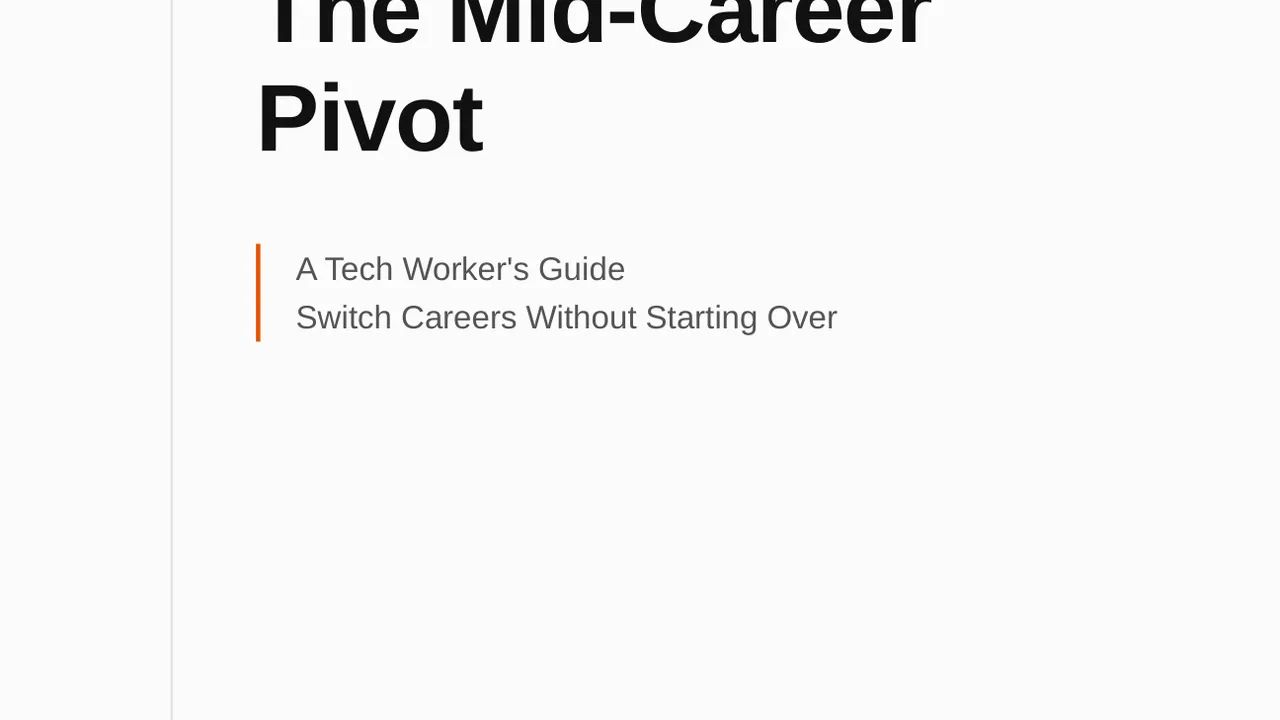
None of these answers is right for everyone. The book I am reviewing here, The Mid-Career Pivot, does something useful. It does not tell you which path to choose. It gives you a framework for figuring out which path fits you, which is a more honest and more useful approach.
Why the Standard Advice Falls Short
The conventional wisdom for mid-career tech workers follows a narrow script. Become a staff engineer. Move into engineering management. Transition to product management. Start a consultancy. Each of these is a legitimate path, but the advice usually skips the hard part. The hard part is not knowing the options. It is knowing yourself well enough to pick the right one.
A staff engineer role sounds great until you realize it involves more politics than coding, because large organizations need seniorindividual contributors to influence without authority. Management sounds like a promotion until you realize your day becomes a series of difficult conversations with no clear feedback loop. Consulting sounds liberating until you experience the feast-or-famine sales cycle. Each path has a cost, and the cost is different for different people.
The most valuable insight in this book is that career satisfaction is mostly about the ratio of energy-draining activities to energy-giving activities in your actual day, not about your title or salary. A pivot that changes your title but keeps the same draining activities will not fix anything.
The Adjacent Possible
One concept from the book that stuck with me is the adjacent possible. You do not need to make a dramatic leap from one career to a completely different one. You need to take one step sideways into a space that combines your existing skills with something you want to learn.
A backend engineer who wants more human interaction does not need to become a therapist. They can move into developer relations, technical writing, or sales engineering, roles that leverage their technical background while shifting the daily work toward communication. A team lead who is tired of performance reviews can move into technical program management, where the scope is broader and the people management component is lighter.
The adjacent possible is easier to find and less risky than a full pivot. It also preserves your earning power during the transition, because you are not starting from zero.
The Financial Reality of a Pivot
This is the part most career advice glosses over. A pivot usually means a pay cut, at least temporarily. Moving to a new role where you have less experience means you are competing with people who have more. The market prices that gap.
The book addresses this honestly. It recommends building a financial buffer before making any move, ideally six months of expenses. It also recommends testing your new direction before committing. Write a sample of the work you want to do. Talk to people already in that role about what their day actually looks like. Take a small contract or side project in the new area before leaving your current position.
The people who succeed at pivots are not the ones who quit and hope. They are the ones who validate their assumptions before they burn the bridge.
A Honest Assessment of the Book
The Mid-Career Pivot is a practical workbook more than a manifesto. It is organized around exercises: mapping your current satisfaction across different work dimensions, identifying your transferable skills, researching potential paths, and planning the transition step by step. The writing is direct and avoids the motivational tone that makes most career books feel like they are selling a fantasy.
The weakness is that the book is tech-focused, which is also its strength depending on who you are. If you work in a completely different industry, some of the role-specific examples will not apply. The framework itself is general enough to be useful, but the examples assume a reader with a technical background.
For a tech worker in their thirties or forties wondering what comes next, this is probably the most useful single resource I have found on the topic. It does not promise an easy answer. It promises a structured way to find your own.
If the question of what comes next in your career is pressing, read more at The Mid-Career Pivot on Amazon.
Related Posts

Why Your Characterization Data Needs a Better Home Than Scattered Files
XRD patterns, SEM images, DSC curves, and TGA data are only useful if you can find them later. A structured characterization lab notebook bridges the gap between instrument output and meaningful analysis.

Brain Games That Do Not Feel Like Homework
Most puzzle books are either too easy for adults or too hard for casual play. Organ's Adventure finds a middle ground, with gentle challenges that build cognitive skills without the frustration.

Keeping a Lab Notebook That Actually Helps in Semiconductor Processing
A review of why a structured lab notebook matters more in semiconductor processing than in most other engineering disciplines, and how the right notebook format saves time and prevents costly mistakes.